
European vs American Roulette — Why It Matters
The extra zero on American roulette nearly doubles the house edge. That single sentence contains the most important piece of roulette knowledge available, and it takes approximately three seconds to read. Yet a significant number of UK players still play American roulette without understanding that they are paying nearly twice as much per spin for a game that is functionally identical to European roulette in every way except the cost.
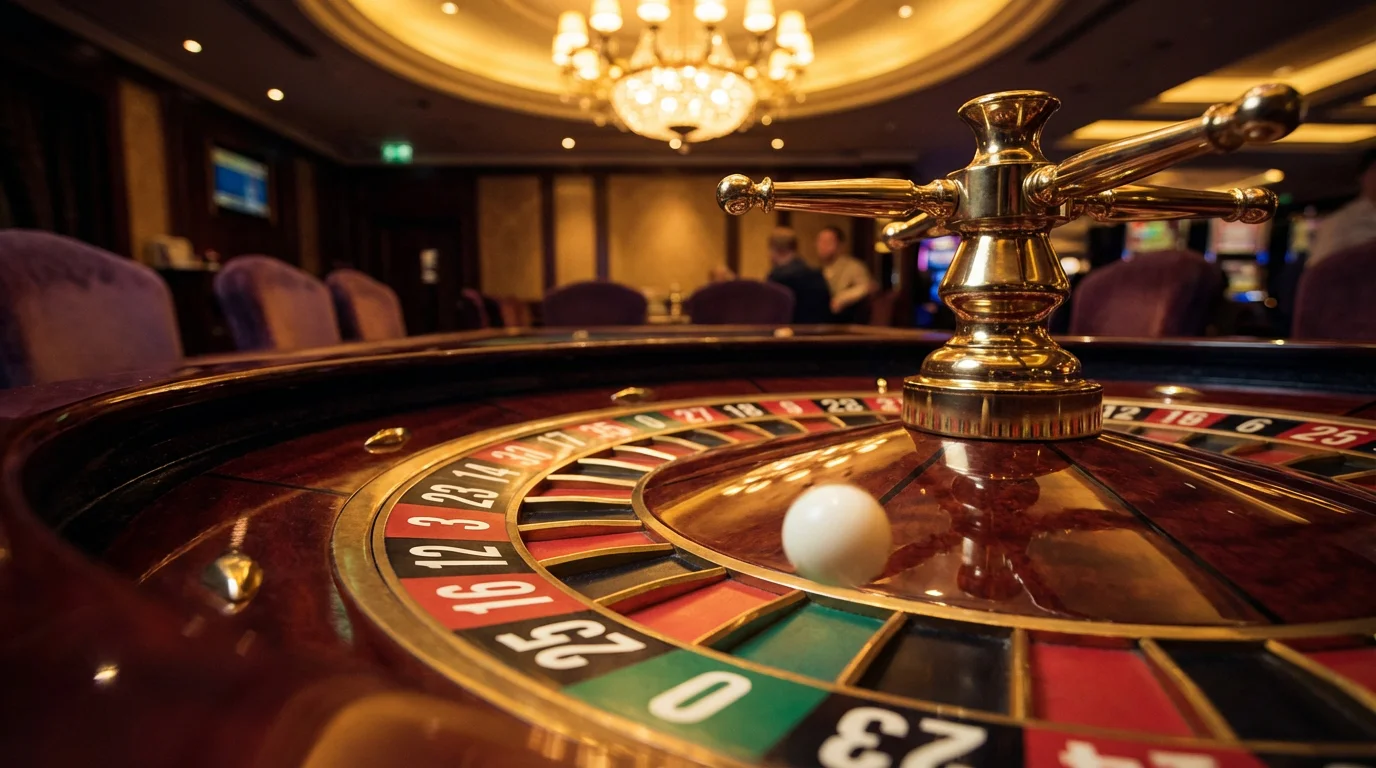
European roulette uses a wheel with 37 pockets: numbers 1 through 36, alternating red and black, plus a single green zero. The zero is the casino’s edge — it is the pocket that ensures all bets have a negative expected value. When you bet on red, there are 18 red numbers and 19 non-red numbers (18 black plus the zero). The probability of winning is 18/37, but the payout is 1:1, as if the odds were 18/36. That gap gives European roulette a house edge of 2.7% on all standard bets.
American roulette adds a second green pocket — the double zero. The wheel has 38 pockets. The same red bet now faces 18 red numbers and 20 non-red numbers (18 black plus two zeros). The payout remains 1:1. The house edge jumps to 5.26%. No strategy, no betting system, and no amount of luck changes this fundamental arithmetic. Every bet on an American roulette wheel costs approximately twice as much per pound wagered as the same bet on a European wheel.
French roulette is European roulette with an additional rule that further reduces the edge. The La Partage rule applies to even-money bets (red/black, odd/even, high/low): if the ball lands on zero, you lose only half your even-money bet instead of the full amount. This effectively halves the house edge on these bets from 2.7% to 1.35%, making French roulette with La Partage the most cost-efficient roulette variant available at UK casinos. Not every casino offers it, but those that do are giving you a meaningfully better deal on the most common bet types.
The practical implication is unambiguous: always play European or French roulette. If a casino offers both European and American variants, there is no rational reason to choose the American wheel. The game feels the same, the betting options are the same, and the payouts are the same. Only the cost is different.
Bet Types and Their Odds
Every roulette bet has the same house edge — the payout just changes the risk profile. This is one of the cleanest mathematical properties in any casino game. On a European wheel, every standard bet carries a 2.7% house edge. What varies is the probability of winning and the corresponding payout.
Inside bets are placed on specific numbers or small groups of numbers on the inner section of the betting layout. A straight-up bet on a single number pays 35:1 with a probability of 2.7% (1 in 37). A split bet on two adjacent numbers pays 17:1 with a probability of 5.4%. A street bet covering three numbers pays 11:1 at 8.1%. A corner bet on four numbers pays 8:1 at 10.8%. A six-line bet covering six numbers pays 5:1 at 16.2%. The house edge on every one of these bets is 2.7%. The difference is entirely in the volatility — how often you win and how much each win pays.
Outside bets cover larger groups of numbers and offer lower payouts with higher probabilities. Red/black, odd/even, and high/low are even-money bets, paying 1:1 with a 48.6% probability of winning (18 out of 37). Dozens bets cover 12 numbers and pay 2:1 at 32.4%. Column bets also cover 12 numbers and pay 2:1 at 32.4%. Again, the house edge is 2.7% on all of them. The only advantage of outside bets is lower variance — you win more often, but each win returns less.
Call bets — Voisins du Zero, Tiers du Cylindre, Orphelins — are combinations of inside bets that cover specific sections of the wheel. They are more common in European and French roulette and are placed based on the physical position of numbers on the wheel rather than their position on the betting layout. These bets are pre-packaged combinations, and their house edge is the same 2.7% because they are composed of standard inside bets. They add a layer of tradition and ritual, particularly in live roulette, but they do not change the mathematics.
The implication for players is that bet selection in roulette is purely a choice about risk tolerance. If you want frequent, small wins with a steady balance, play outside bets. If you want infrequent, large wins with significant swings, play inside bets. The cost per pound wagered is identical either way. The only variable is how much volatility you are comfortable with.
Live Roulette and Game-Show Variants
Game-show roulette adds excitement — and higher variance. The live roulette category at UK casinos has expanded well beyond the standard wheel, and the newer variants introduce mechanics that meaningfully alter the playing experience even if the core game remains recognisable.
Standard live roulette — European Roulette streamed from a studio with a real dealer and a physical wheel — is the baseline product. The house edge is 2.7%, identical to RNG roulette. The pace is slower (one spin every 30 to 60 seconds depending on the table), which means the hourly cost is lower than rapid-fire RNG versions. The appeal is the visible, physical outcome and the social environment of the live table.
Lightning Roulette, developed by Evolution, adds random multipliers to straight-up bets. Before each spin, one to five numbers are selected at random and assigned multipliers of 50x, 100x, 200x, 300x, or 500x. If the ball lands on a multiplied number and you have a straight-up bet on it, the payout is the multiplied amount instead of the standard 35:1. The trade-off is that the standard straight-up payout is reduced from 35:1 to 29:1 for non-multiplied numbers. The overall house edge is slightly higher than standard roulette — approximately 2.9% on straight-up bets (RTP 97.10%) compared to 2.7% on standard European roulette — but the variance is dramatically increased. You are trading consistency for the chance of a large single-spin payout.
Immersive Roulette uses multiple camera angles and slow-motion replays to create a cinematic presentation of the standard game. The rules and odds are unchanged. Double Ball Roulette uses two balls on a single wheel, creating new bet types and altered probabilities. These variants are entertainment innovations — they change how the game feels, not how the mathematics work, though Double Ball does introduce unique odds worth checking in the game information screen.
The common thread across all variants is that the core mathematical relationship between bets, payouts, and probability remains governed by the number of pockets on the wheel. Presentation changes. Mechanics shift. The edge persists.
The Wheel Doesn’t Have a Memory
No pattern, no system, no memory — just probability. This is the single most important thing to understand about roulette, and it is the single most commonly disbelieved truth in gambling.
The gambler’s fallacy — the belief that past outcomes influence future ones — is nowhere more persistent than at the roulette table. If red has come up seven times in a row, the fallacy tells you that black is “due.” It is not. The probability of black on the next spin is 18/37, exactly as it was before the streak and exactly as it will be after it. The wheel has no memory. Each spin is an independent event, determined by the physical mechanics of the ball and the wheel, unaffected by any sequence of previous results.
Betting systems built on the fallacy — Martingale, Fibonacci, D’Alembert, Labouchere — do not overcome the house edge. The Martingale system, which instructs you to double your bet after every loss, guarantees recovery of previous losses only if you have infinite money and the table has no maximum bet limit. In reality, you have neither. A losing streak of sufficient length — which is mathematically certain to occur given enough play — will either exhaust your bankroll or hit the table limit, leaving you with a catastrophic loss that the system cannot recover.
Roulette is a game of pure chance with a known, fixed cost. The cost is 2.7% of every pound you wager on a European wheel, 1.35% on even-money bets at a French table, and 5.26% on an American wheel. No decision you make changes these numbers. The only decisions that matter are which variant to play, how much to wager, and when to stop. Everything else is theatre — enjoyable, sometimes thrilling, but mathematically irrelevant.