

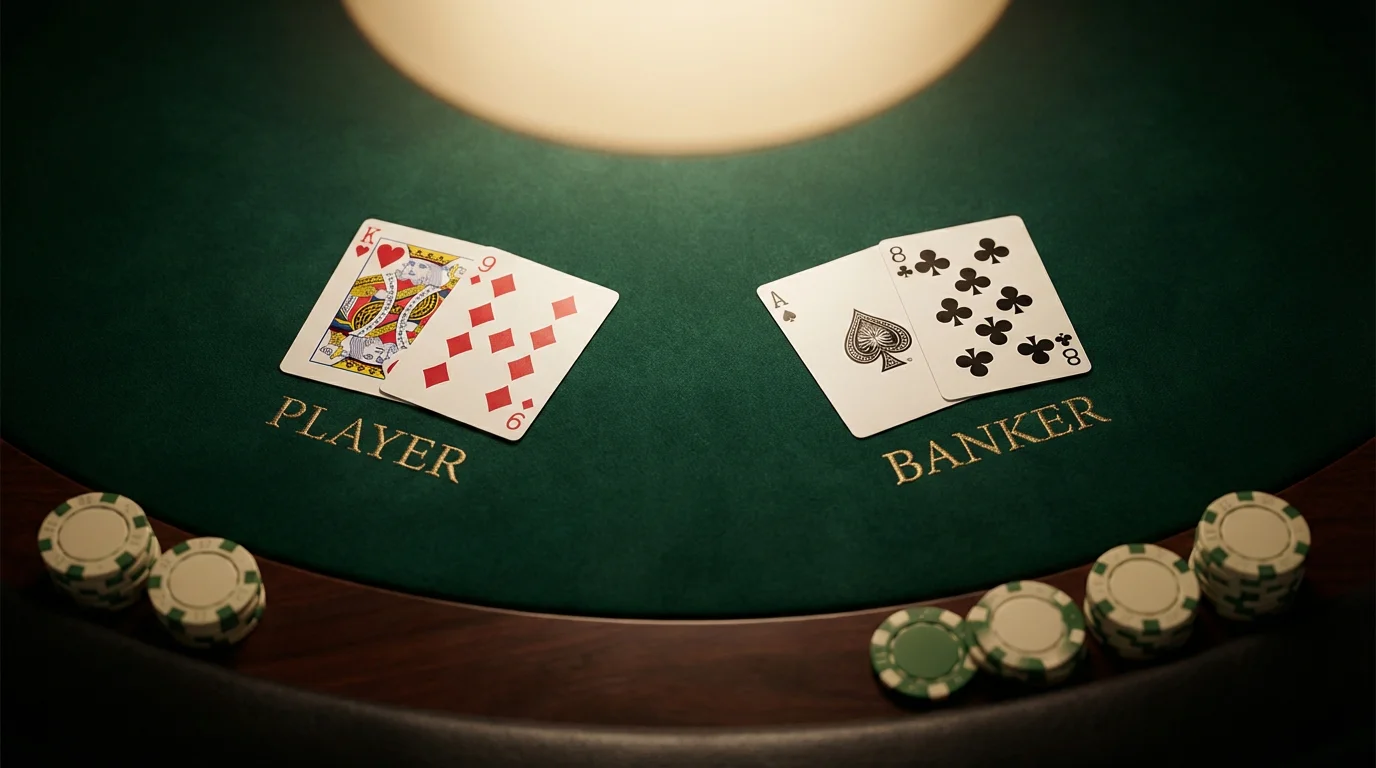
How Baccarat Works
Baccarat is the simplest table game — and one of the best value. You make a single decision before the hand begins: bet on the player, the banker, or a tie. After that, the cards determine the outcome according to fixed rules. No hitting or standing decisions, no splitting, no doubling down. The entire game plays itself once the bet is placed, which makes it simultaneously the easiest casino game to learn and one of the most difficult to overthink.
The objective is to bet on which hand — player or banker — will have a total closest to 9. Cards are valued as follows: Aces count as 1, cards 2 through 9 are worth their face value, and 10s, Jacks, Queens, and Kings count as 0. If a hand’s total exceeds 9, only the second digit counts — a hand of 7 and 8 totalling 15 becomes 5. This modular arithmetic means the maximum possible hand value is 9 and the minimum is 0.
The initial deal gives two cards each to the player hand and the banker hand. If either hand totals 8 or 9 on the first two cards, this is a “natural” and the round ends immediately — the higher natural wins, or the round is a tie if both are equal. If neither hand has a natural, the third-card rules determine whether additional cards are drawn. The player hand draws a third card if its total is 0 through 5, and stands on 6 or 7. The banker’s third-card decision depends on both its own total and whether the player drew a third card (and if so, what that card was). These rules are fixed and applied automatically — neither the player nor the dealer exercises discretion.
The complexity of the third-card rules sounds daunting on paper, but in practice it is irrelevant to the player. You do not need to know the third-card table to play baccarat. The dealer (in live games) or the software (in RNG games) applies the rules automatically. Your only decision is the initial bet. Everything else is procedure.
Why Banker Is the Smart Bet — and What the Commission Costs
The banker bet wins more often — which is why the casino charges a commission on it. The mathematical structure of baccarat gives the banker hand a slight statistical advantage due to the third-card rules, which favour the banker in certain drawing situations. Over a very large number of hands, the banker bet wins approximately 45.86% of the time (excluding ties), the player bet wins approximately 44.62%, and the tie occurs approximately 9.52%.
This asymmetry means the banker bet has a lower house edge than the player bet: approximately 1.06% versus 1.24%. Both figures are among the lowest in the casino — significantly better than roulette (2.7%), most slots (3-6%), and virtually all side bets. The banker bet’s edge is held down by the 5% commission that most casinos charge on winning banker bets. Without the commission, the banker bet would have a player advantage — which is precisely why the commission exists. It is the mechanism that ensures the casino retains its edge on the statistically stronger side.
The tie bet is a different proposition entirely. It pays 8:1 or 9:1 depending on the casino, but the true odds of a tie are roughly 9.5:1. The resulting house edge is approximately 14.4% at 8:1 payout and approximately 4.8% at 9:1. At the standard 8:1 payout, the tie bet is one of the worst wagers available at any casino table game. The payout looks attractive, but the mathematics are brutal. Consistent baccarat players avoid it entirely.
For the rational player, the decision framework is minimal. Bet on the banker. Accept the 5% commission as the cost of the lowest house edge available. Avoid the tie. The player bet is a reasonable alternative — the 0.18% difference in edge between banker and player is small enough that it will not materially affect a casual session — but over thousands of hands, the banker bet saves you more than any other single decision in baccarat.
Baccarat Variants at UK Online Casinos
Most online baccarat is Punto Banco — the rest is variations on speed and stakes. Punto Banco is the standard version of baccarat played at virtually every casino in the world, and it is the only version available at the overwhelming majority of UK online casinos. The name simply means “player banker” in the style of play where the third-card rules are fully automated and no discretion is exercised by any party. If you are playing baccarat online, you are almost certainly playing Punto Banco.
Mini Baccarat is Punto Banco with lower table limits and a faster pace. In live casino settings, Mini Baccarat tables often have lower minimum bets (starting from £1 to £5) and accommodate more players. The rules are identical. The difference is accessibility — Mini Baccarat is designed for players who want the game without the high-roller atmosphere traditionally associated with full-scale baccarat.
Speed Baccarat compresses the dealing process. In standard live baccarat, the dealer reveals cards with a deliberate pace, sometimes with a squeeze (slowly peeling back the cards for dramatic effect). Speed Baccarat eliminates the ceremony — cards are dealt face-up immediately, and each round completes in approximately 27 seconds compared to the standard 48 seconds. For players who value efficiency over atmosphere, Speed Baccarat offers more hands per hour at the same odds.
Lightning Baccarat, from Evolution, applies the multiplier mechanic familiar from Lightning Roulette. Before each round, random cards are assigned multipliers of 2x, 3x, 4x, 5x, or 8x. If those cards appear in the winning hand and you bet on the correct side, your payout is multiplied accordingly. The trade-off is a 20% fee on each bet, which increases the effective house edge. Lightning Baccarat is a higher-variance, higher-cost version of the standard game — it trades the low edge that makes baccarat attractive for the possibility of amplified payouts.
No-commission baccarat removes the 5% commission on winning banker bets but introduces an alternative rule: if the banker wins with a total of 6, the payout is reduced to 0.5:1 instead of the standard 1:1. This modification preserves the casino’s edge while simplifying the payout structure. The overall house edge on the banker bet in no-commission variants is slightly higher than the standard version — approximately 1.46% versus 1.06% — which means the convenience of no commission comes at a measurable cost.
Elegant, Fast, and Mathematically Understood
Baccarat does not require strategy — just the discipline to bet on the right side. That sentence is both the game’s greatest strength and its limitation. There is nothing to learn, nothing to optimise, and nothing to master. The banker bet at 1.06% is the correct choice. Avoiding the tie bet is the correct choice. Beyond that, there are no decisions to improve.
What baccarat offers instead is efficiency. The house edge on the banker bet is lower than blackjack played without basic strategy, lower than every form of roulette, and lower than virtually every slot. A player wagering £10 per hand at baccarat for 80 hands per hour faces an expected cost of approximately £8.50 per hour. The same £10 per spin on European roulette costs approximately £21.60. Baccarat is one of the cheapest table games in the casino to play, measured by cost per hour and cost per pound wagered.
The game attracts players who want low-edge betting without the study required for blackjack basic strategy and without the theatrical complexity of live game shows. It is fast, it is mathematically transparent, and it has a clarity that most casino games lack. You bet. The cards are dealt. One side wins. The maths is settled. Whether you play Punto Banco for the elegance or Speed Baccarat for the efficiency, the underlying proposition is the same: a simple game with a known cost and no pretensions about what it is.
Find more table game guides at legitonlinecasinouk. Also read our online roulette UK.