

What House Edge Means in Practice
The house edge is the casino’s business model — expressed as a percentage. It is not a fee deducted from each bet, not a hidden surcharge applied at withdrawal, and not a dial the casino adjusts depending on who is playing. It is a statistical property embedded in the rules of each game, and it describes the proportion of all money wagered that the casino expects to retain over time.
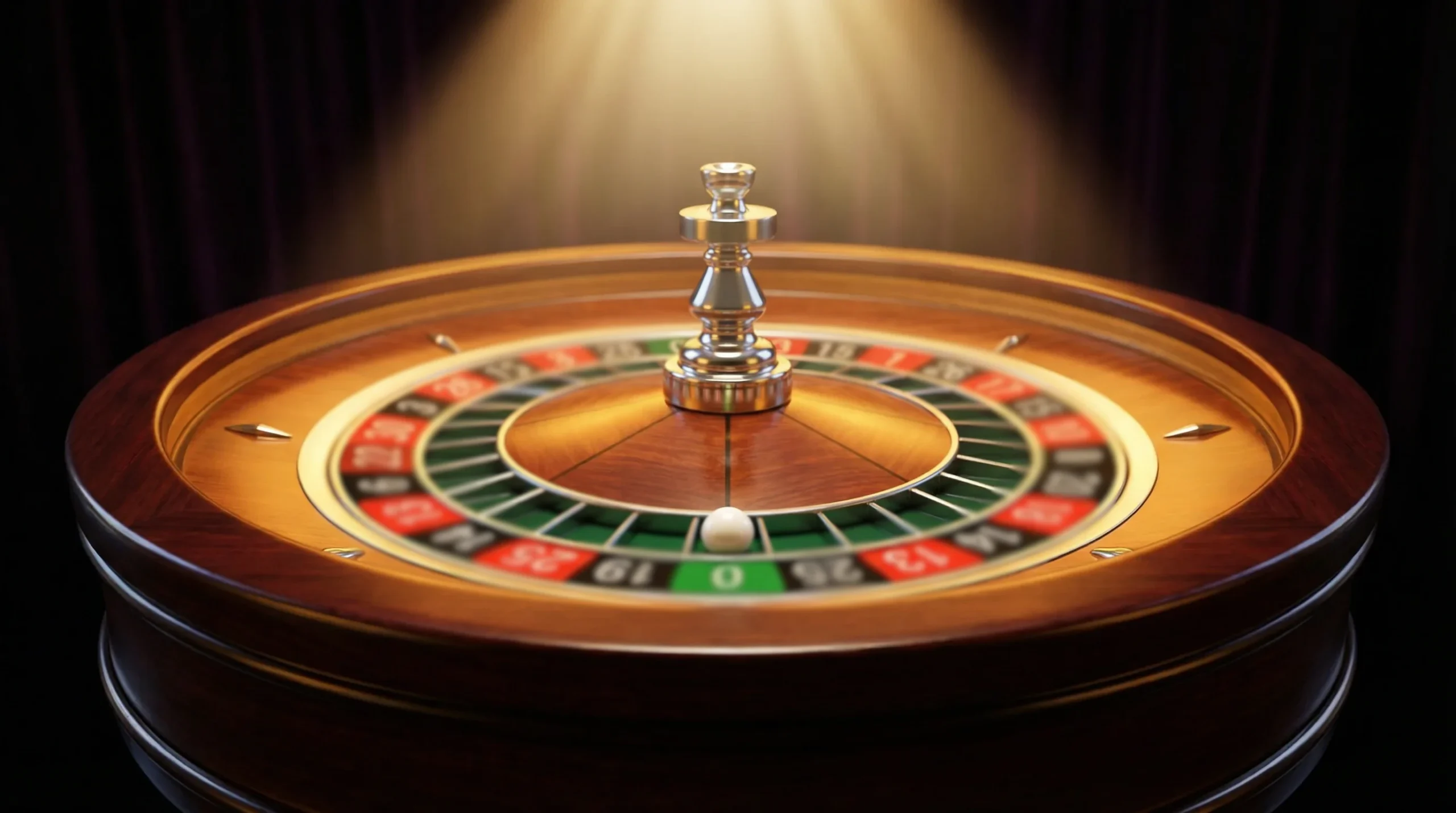
A European roulette wheel has 37 numbered pockets: 1 through 36 plus a single zero. If you place a straight-up bet on number 17 and win, the payout is 35 to 1. But the true odds of landing on 17 are 36 to 1, because there are 36 other pockets where the ball could land. That gap — between the payout ratio and the true probability — is the house edge. For European roulette, it works out to 2.7%. For every £100 wagered across all bets on the table over a long enough period, the casino expects to keep £2.70. The remaining £97.30 is redistributed to players as winnings.
The critical word is “expects.” The house edge is a long-term average, not a per-session guarantee. In any given hour, day, or week, actual results can deviate dramatically from the mathematical expectation. A single player might win £500 at a game with a 2.7% house edge, while the player at the next table loses £300. Neither result contradicts the edge — both are normal fluctuations within the range of short-term variance. The edge only converges on its stated value across a very large number of bets, typically hundreds of thousands or millions.
This is why the house edge is best understood not as a prediction of your personal outcome but as the cost of the game per unit wagered. If you wager £1,000 over a session of European roulette, the expected cost of that session is £27 (£1,000 multiplied by 0.027). You might finish up £200. You might finish down £150. But the mathematical price tag on the entertainment is £27, and over enough sessions, your average result will drift toward that figure.
Casinos are profitable not because they win every bet or every session, but because the edge is persistent and the volume is enormous. Thousands of players placing thousands of bets every day produce a total wagering volume that is large enough for the law of large numbers to take effect. The casino does not need to beat you specifically. It needs the aggregate of all players’ wagers to converge on the expected edge, and given sufficient volume, it always does.
House Edge by Game Type
Every game has a different cost per hour — the house edge is how you calculate it. Choosing between games is, among other things, a decision about how much you are willing to pay for the time you spend playing. The differences are not trivial.
Blackjack offers the lowest house edge available at most UK online casinos, provided you play with optimal strategy. Basic strategy — a mathematically derived set of rules that dictates the correct action for every possible hand combination — reduces the house edge to approximately 0.5% on a standard game with favourable rules (dealer stands on soft 17, blackjack pays 3:2, doubling after splitting allowed). That means a player wagering £1,000 over a session has an expected cost of just £5. The catch is that 0.5% assumes perfect play. Deviation from basic strategy — hitting when you should stand, not splitting when you should — increases the effective edge. Casual players who rely on instinct rather than strategy typically face a house edge closer to 2% to 3%.
European roulette carries a house edge of 2.7%, derived from the single zero pocket. American roulette, with its additional double zero, jumps to 5.26% — nearly double the cost for the same game mechanics. This is why European roulette is the standard offering at UK online casinos, and why American roulette, where available, should be treated as a more expensive variant rather than an equivalent alternative. French roulette with the La Partage rule reduces the effective edge on even-money bets (red/black, odd/even) to 1.35%, making it the most cost-efficient roulette option available.
Baccarat is a low-edge game that requires no strategic decisions from the player. The banker bet carries a house edge of approximately 1.06%, the player bet sits at 1.24%, and the tie bet — which should be avoided by anyone who has read this paragraph — carries an edge of roughly 14.4%. The simplicity of baccarat combined with the low edge on the two main bets makes it a favourite among high-stakes players who prefer a game where the maths is favourable and the decisions are straightforward.
Online slots have the widest range of house edges in any game category. A slot with a 97% RTP has a 3% house edge. A slot with a 94% RTP has a 6% edge. That difference — 3% versus 6% — means one slot costs twice as much per pound wagered as the other. Over a session involving £500 in total wagers, the cheaper slot costs £15 in expected terms; the more expensive one costs £30. Given that slot RTPs are published and accessible in the game information screen, choosing a higher-RTP slot is one of the few things a player can do to directly reduce their expected cost.
Casino poker variants — Casino Hold’em, Three Card Poker, Caribbean Stud — typically carry house edges between 2% and 5%, depending on the variant and the optimal strategy. These games combine elements of skill (knowing when to raise or fold) with fixed payout structures that ensure the house retains its edge regardless of the player’s strategy. Video poker, when played with optimal strategy on a full-pay machine, can achieve edges below 1%, though full-pay variants are rare in the UK online market.
To convert house edge into a practical cost-per-hour figure, multiply the edge by your average wager size and by the number of bets per hour. A blackjack player wagering £10 per hand at 60 hands per hour with a 0.5% edge spends £600 in total wagers and faces an expected cost of £3 per hour. A slots player spinning at £1 per spin at 600 spins per hour with a 4% edge faces an expected cost of £24 per hour. The faster the game and the higher the edge, the more expensive the session.
Why You Can Win Despite the Edge — and Why It Doesn’t Last
Winning does not disprove the edge. It just means variance was on your side. This distinction is the most commonly misunderstood aspect of casino mathematics, and it is the reason why personal experience is a poor guide to how gambling actually works.
Variance — the statistical term for the spread of possible outcomes around the expected average — is what makes short-term winning possible. The house edge describes where the average sits over millions of bets. Variance describes how far individual results can stray from that average in the short term. A game with high variance produces dramatic swings: long losing streaks followed by large wins, or vice versa. A game with low variance produces results that cluster more tightly around the expected average, with smaller and more frequent wins and losses.
In practical terms, variance means that a player can sit down at a roulette table with a 2.7% house edge and walk away up 50% after an hour. The maths says the expected cost was 2.7% of total wagers. The actual result was a significant profit. These two facts are not in conflict. The expected value is a long-run average; the actual result is a single data point from a distribution that includes outcomes far above and far below that average. One hour, one session, even one month of play is not enough data for the average to assert itself.
The reason it does not last — the reason the edge eventually wins — is the law of large numbers. As the number of bets increases, the average result moves closer to the expected value. A player who places 100 bets on European roulette might be up 20%. A player who places 10,000 bets will almost certainly be within a few percentage points of the 2.7% expected loss. A player who places 1,000,000 bets will be so close to the mathematical expectation that the difference is negligible. The casino operates at the million-bet scale. Individual players do not.
This asymmetry is the foundation of the casino business. The casino has time and volume on its side. The player has variance — the possibility of winning in the short term — but no mechanism for locking in those gains against the mathematical tide. The rational response to this asymmetry is not to avoid gambling, but to understand it: set session budgets based on expected cost, treat wins as fortunate variance rather than a repeatable outcome, and recognise that the longer you play, the more your results will resemble the edge.
The Edge Is the Admission Fee
Know the price before you play. The house edge is not a secret, not a conspiracy, and not something the casino hides from you. It is published in the RTP of every slot, derivable from the payout tables of every table game, and documented in every credible gambling mathematics resource available online. The information is there. The question is whether you use it.
Thinking of the house edge as an admission fee changes the psychology of the experience. A cinema ticket costs £12 for two hours of entertainment. A concert ticket costs £80 for three hours. A session of European roulette at £10 per spin, 30 spins per hour, for two hours costs approximately £16 in expected terms (£600 total wagers multiplied by 0.027). That £16 is the price of the entertainment. You might leave with more than you started with — variance allows for that — but the expected cost is £16, and knowing that figure before you sit down is the difference between informed entertainment and uninformed hope.
The house edge does not make gambling irrational. It makes gambling a product with a defined cost, like any other form of entertainment. What makes gambling problematic is misunderstanding that cost — believing you are investing rather than spending, expecting long-term profits from a negative-expectation game, or chasing losses on the assumption that the maths will eventually reverse in your favour. It will not. The edge is permanent, consistent, and mathematically inescapable over sufficient volume.
Play the games you enjoy. Choose the ones with the lowest edge if cost matters to you. Set a budget that reflects the expected price of the session, not the jackpot you hope to win. And understand that the casino is not your opponent — the house edge is simply the mechanism by which the product is priced. You are paying for the experience. The edge is how much it costs.
Find more RTP guides at legitonlinecasinouk. Also explore our RTP games guide.