

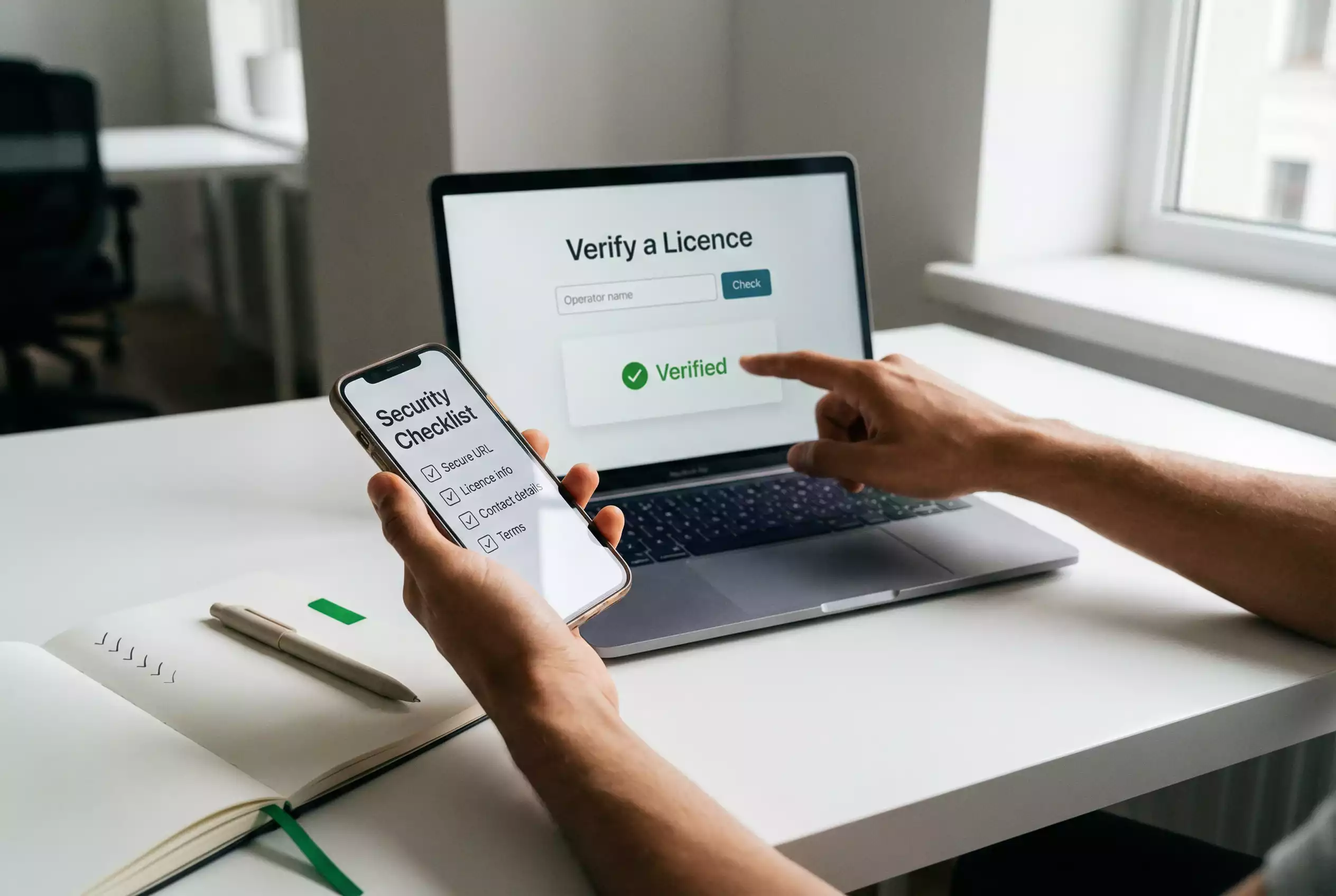
Before you deposit a single pound at any online casino, there is a set of checks you can run in under five minutes that will tell you whether the site is legitimate, licensed, and safe — or whether you should close the tab and never return. This is not a vague suggestion to “do your research.” It is a specific, repeatable process, and the fact that most players skip it entirely is the reason rogue operators continue to find victims.
This article is the checklist. It walks through every verification step in order, from the fastest and most decisive — confirming a UKGC licence — to the slower, more nuanced signals that separate a merely licensed casino from one that actually deserves your trust. If you are the kind of player who reads terms before clicking “accept,” you will find this useful. If you are the kind who has never checked a licence number in your life, this might be the most important five minutes you spend before your next session.
The 5-Minute Legitimacy Check — What to Do Before You Deposit
Five minutes of checking can save you from months of chasing a payout. The process is not complicated, but it needs to be systematic. Random browsing does not count. You are looking for specific, verifiable indicators — and the absence of any one of them is a reason to walk away.
Start with the licence. Scroll to the footer of the casino’s website and look for a UK Gambling Commission licence number. It should be displayed prominently, usually alongside a UKGC logo. If there is no licence number visible, stop. Do not proceed. No legitimate UK-facing casino omits this information, because displaying it is a licence condition. The number itself is not enough — you need to verify it against the UKGC’s public register, which is free and takes seconds. More on that process in the next section.
Next, check the connection. Look at the browser address bar: the URL should begin with “https” and display a padlock icon. This indicates that the site uses SSL/TLS encryption, which protects the data you transmit — including your payment details and personal information — from being intercepted. Every serious operator uses HTTPS. A site running on plain HTTP in 2026 is either negligently managed or deliberately insecure, and neither possibility is reassuring.
Look for game fairness credentials. Reputable casinos display seals or logos from independent testing bodies such as eCOGRA, iTech Labs, or GLI. These organisations audit the casino’s random number generators and publish certification reports confirming that game outcomes are fair. The presence of a testing seal is not proof by itself — seals can be faked — but it is one piece of a larger picture that you are assembling.
Check the payment methods. Licensed UK casinos accept established payment providers: Visa and Mastercard debit cards, PayPal, Skrill, Neteller, bank transfers. If a site only accepts cryptocurrency or obscure payment processors you have never heard of, that is a concern. Major payment providers conduct their own due diligence on the merchants they work with, so their presence on a casino site functions as an additional, informal layer of verification. PayPal, in particular, only partners with operators it has independently vetted.
Finally, look at the terms and conditions. They should be accessible from the homepage, clearly written, and specific about bonus wagering requirements, withdrawal limits, and the complaints process. Vague terms, missing information, or terms that seem designed to make withdrawals as difficult as possible are among the clearest signals that something is wrong. A legitimate casino has nothing to hide in its terms, because its terms are built around regulatory requirements it is already obliged to meet.
None of these checks is conclusive on its own. Together, they form a picture. A site that passes all five — licence, encryption, fairness seals, reputable payment methods, transparent terms — is almost certainly legitimate. A site that fails on even one of them deserves significantly more scrutiny before you enter your card details.
How to Verify a Casino’s UKGC Licence Number
The UKGC register is public, free, and takes thirty seconds to search. It is the single most definitive check you can perform, and there is no reason not to perform it every time you consider a new casino.
Here is how it works. Go to the UKGC’s official website at gamblingcommission.gov.uk. Navigate to the public register — it is accessible from the main menu under the licensing section. You can search by account number, which is the licence number the casino displays in its footer, or by the name of the licence holder. Enter the number and search. The register will return a result showing the licence holder’s name, the type of licence held, the licence status (active, suspended, surrendered, or revoked), and the activities the licence covers.
This is where it gets important: compare what the register tells you with what the casino’s website claims. The licence status must be active. The licence type must include remote casino activities if you are playing casino games. And the operator name on the register must match the entity operating the casino — though this is not always as straightforward as it sounds, because the trading name you see on the website often differs from the legal entity name on the licence.
Pay attention to the details. A licence that covers only betting but not casino activities does not authorise the operator to offer slots or table games. A licence that is listed as suspended means the operator is under regulatory review and may not be legally providing services. A licence that has been surrendered or revoked means the operator no longer has permission to operate in the UK at all. Any of these discrepancies should end your interest in that particular site immediately.
If you want to go deeper, the UKGC register also shows whether the operator has been subject to any regulatory actions — fines, licence conditions, or public statements. This history is not hidden; it is part of the public record. An operator with a clean enforcement history is not necessarily better than one with a resolved regulatory action, but a pattern of repeated violations is a meaningful signal about how seriously the operator takes its obligations.
Why the Operator Name Might Not Match the Casino Brand
The casino brand you see advertised is rarely the legal entity that holds the licence. This is normal and not inherently suspicious — it is simply how the industry is structured. Large operator groups run multiple casino brands under a single licence. White-label platforms provide the software and regulatory infrastructure, allowing smaller brands to operate under the parent company’s licence. The result is that a casino called “Lucky Spin Palace” might be operated by a company called “ProgressPlay Limited” or “Jumpman Gaming Limited,” and the UKGC licence is issued to the parent entity, not the brand.
This means you need to cross-reference. The casino’s footer or terms and conditions should state the name of the company that operates the site. Take that name and search it on the UKGC register. If the name matches a valid, active licence holder, and the licence covers the activities the casino offers, you are in the clear. If the operator name listed on the site does not appear on the register, or if the licence belongs to a different entity entirely, that is a red flag worth investigating further before you proceed.
Some of the largest operator groups in the UK market run dozens of casino brands under a single licence. This is efficient from a regulatory perspective — one compliance team, one licence, multiple front-end brands — but it can be confusing for players who expect a one-to-one relationship between the casino name and the licence holder. The key is not to be alarmed by the mismatch, but to verify that the chain of ownership is legitimate. The information is public. The register is free. There is no excuse for not checking.
Red Flags That Scam Casinos Can’t Hide
Scam casinos follow patterns — once you learn them, they are hard to miss. The operators behind rogue sites are not criminal masterminds running bespoke operations. They are cutting corners at scale, and those corners leave visible marks that an attentive player can spot before a single penny changes hands.
The most obvious red flag is the absence of a UKGC licence number. If a casino targets UK players — through English-language content, pricing in pounds sterling, UK-specific payment methods, or British advertising — but does not display a UKGC licence number, it is almost certainly operating illegally in the UK market. Some of these sites will display a licence from another jurisdiction, typically Curacao or Anjouan, as if that provides equivalent protection. It does not. A Curacao licence does not authorise an operator to serve UK customers, and the regulatory protections attached to it are a fraction of what the UKGC provides.
Unrealistic bonus terms are another consistent marker. A welcome bonus with a wagering requirement above fifty times is aggressive by industry standards. A requirement of one hundred times or more is functionally impossible to clear and exists primarily to prevent withdrawals while keeping the player depositing. Similarly, bonuses with no maximum cashout cap might sound generous until you discover that the operator reserves the right to void winnings exceeding an undisclosed threshold. If the bonus terms seem too good to be true, they are structured so that the operator never has to honour them.
Withdrawal stalling is a classic tactic. Rogue casinos will accept deposits instantly but impose unexplained delays on withdrawals — requesting additional verification documents weeks after the initial KYC was completed, introducing “security reviews” that coincide suspiciously with large withdrawal requests, or applying processing times measured in weeks rather than days. Licensed casinos have processing times too, but they disclose them in their terms and they adhere to them. If you find yourself chasing a payout through support tickets that go unanswered, that is not a processing delay. That is a business model.
Poor-quality websites are an underrated signal. Scam casinos frequently use white-label templates with minimal customisation — the same layout, the same game providers, the same stock imagery across dozens of nominally different brands. If a site looks like it was assembled in an afternoon and has no original content, no detailed information pages, and no evidence of investment in the player experience, it probably was. Legitimate operators spend significant money on their platforms, because they plan to be around long enough to earn it back. Sites built to extract deposits and disappear do not bother with polish.
Fake Licence Numbers and Cloned Credentials
Some rogue operators go further than simply omitting a licence number — they fabricate one. A fake licence number displayed in a website footer, accompanied by a UKGC logo copied from the Commission’s own site, can be convincing enough to satisfy a casual glance. This is precisely why a casual glance is not enough.
The verification process described earlier defeats this tactic completely. A fabricated licence number will return no results on the UKGC public register. A licence number copied from a legitimate operator will return results, but the operator name and authorised activities will not match the site you are investigating. In some cases, rogue sites clone the entire identity of a licensed operator — copying the licence number, the operator name, and even the registered address — and present it on a completely different domain. The UKGC register lists the URLs associated with each licence holder, so if the domain you are visiting is not listed among the operator’s authorised websites, the site is not covered by that licence regardless of what it claims.
The Commission is aware of this tactic and periodically publishes warnings about specific cloned or fraudulent sites. But the most reliable defence is your own verification. The register exists for exactly this purpose. A legitimate casino has no reason to fear you checking it, and a fraudulent one has every reason to hope you will not.
Security and Fairness — What to Look For Beyond the Licence
A licence is the starting point — security infrastructure is the next layer. Once you have confirmed that a casino is UKGC-licensed, you can assess a second tier of indicators that reveal how seriously the operator takes security and fairness beyond the minimum regulatory requirements.
The HTTPS check mentioned earlier is the quickest of these, but the deeper indicators take a bit more digging. Game fairness certifications provide a granular layer of assurance that goes beyond the UKGC’s own requirements. The Commission mandates that all games be tested against its technical standards, but some operators go further by engaging independent auditing bodies — eCOGRA, iTech Labs, GLI — to conduct ongoing testing and publish the results. eCOGRA, for example, publishes monthly payout percentage reports for the operators it audits, showing the actual return to player across different game categories. These reports are accessible from the casino’s website, usually via a link in the footer or a dedicated fairness page. If the reports are current and the numbers align with expected RTP ranges, it confirms that the games are performing within their certified parameters.
Look at the responsible gambling page. Every licensed casino must have one, but the quality varies enormously. A well-maintained responsible gambling section includes direct links to GamStop, GambleAware, and GamCare, clear instructions for setting deposit limits and session reminders, information about the self-exclusion process, and details of the casino’s own customer interaction policies. A token page with a single paragraph and a generic link to a helpline suggests the operator is meeting the letter of its obligations without investing in their spirit.
The terms and conditions are the final layer of this assessment. Read them. Specifically, look for the sections covering bonus terms, withdrawal limits, account closure, and dispute resolution. The bonus terms should specify the wagering requirement, game contribution weights, time limits, and maximum bet rules. The withdrawal section should state processing times, any pending or reversal periods, and the maximum withdrawal amounts per day, week, or month. The dispute resolution section should name the operator’s approved ADR provider. If any of these details are missing, vague, or contradictory, the terms are not fit for purpose — and if the terms are not fit for purpose, you have no reliable basis for understanding what you are agreeing to when you click “register.”
None of these secondary indicators replaces the licence check. But together with it, they build a layered picture of the operator’s credibility that goes well beyond the regulatory minimum. The casinos that invest in these areas are the ones that expect to be scrutinised — and welcome it, because passing scrutiny is a competitive advantage.
Using Player Reviews and Forums — What to Trust
Not all reviews are equal — and the most useful ones are rarely the most visible. The online casino review landscape is dominated by affiliate sites that earn revenue by directing players to specific casinos, which creates an inherent conflict of interest that most of these sites do not adequately disclose. This does not mean every affiliate review is unreliable, but it means you need to read them with a specific kind of scepticism.
The telltale signs of a low-quality review are consistency and enthusiasm. If a site rates every casino it covers at four or five stars, the ratings are meaningless. If the review reads like marketing copy — heavy on bonus amounts, light on terms — it was probably written to convert clicks rather than inform decisions. The best affiliate reviews are the ones that include detailed breakdowns of bonus terms, actual withdrawal timeframes based on testing, and honest assessments of weaknesses alongside strengths. They exist, but you have to look for them.
Player forums offer a different kind of signal. Sites like CasinoMeister, AskGamblers, and dedicated Reddit communities contain thousands of posts from actual players describing their experiences with specific casinos. The value of this feedback is not in individual complaints — every casino generates some — but in patterns. If multiple unrelated players report the same issue — delayed withdrawals, unresponsive support, bonus terms that were changed after acceptance — that pattern is more meaningful than any single review score.
When reading forum feedback, focus on recency and specificity. A complaint from three years ago about slow withdrawals may no longer be relevant if the casino has since changed its payment provider. A complaint from last month about KYC delays is current and worth noting. Look for posts that include specific details — dates, amounts, support interactions — rather than vague statements of dissatisfaction. Specificity correlates with credibility, because fabricating detailed accounts is significantly harder than writing generic negative reviews.
Be aware that casinos sometimes engage in reputation management on forums, either by posting positive reviews through affiliate accounts or by challenging legitimate complaints with legalistic responses designed to discredit the poster. This is not universal, but it happens, and it is another reason to look for patterns rather than relying on any single post. A casino with a hundred posts and a handful of complaints is probably fine. A casino with a hundred posts and fifty complaints about the same issue has a problem that no amount of reputation management can disguise.
The most reliable approach is to triangulate. Check the UKGC register for licence validity and enforcement history. Read the casino’s own terms for transparency and fairness. Then cross-reference with forum feedback for real-world performance. No single source gives you the complete picture, but three independent sources pointing in the same direction give you something close to certainty.
Trust Is Verified, Not Assumed
The casinos that welcome scrutiny are the ones worth playing at. This is not a platitude — it is an observable pattern. Operators that invest in transparency, display their credentials prominently, publish their auditing results, and maintain clear terms have made a calculated decision that informed players are better long-term customers than uninformed ones. They want you to check, because every check you run confirms that they pass.
Verification is not paranoia. It is a skill, and like any skill, it gets faster with practice. The first time you search the UKGC register, it might take a couple of minutes to find the right page and understand what you are looking at. The fifth time, it takes thirty seconds. The process described in this article — licence check, encryption check, fairness seals, payment methods, terms review, forum cross-reference — sounds like a lot when listed out, but in practice it becomes a quick, intuitive routine that you run before depositing at any new site. Five minutes, once, per casino. That is the total cost of the habit.
The alternative is to trust by default. To assume that any site that looks professional enough is legitimate, that any bonus that sounds generous enough is worth claiming, that any operator that accepts your deposit will honour your withdrawal. This works most of the time, because most of the casinos you encounter through mainstream channels are licensed and broadly compliant. But “most of the time” is not a strategy. It is a gamble — and unlike the games themselves, this one offers no entertainment value when it goes wrong.
The UK regulatory framework gives players an unusually strong set of tools for verifying operator legitimacy. The public register is comprehensive and free. The UKGC publishes its enforcement actions. ADR providers exist to resolve disputes. GamStop provides a universal self-exclusion mechanism. These tools were built for you to use. The question is not whether verification is necessary — it is whether you will spend five minutes on it before your next deposit. The casinos that pass the test have no objection to you running it. The ones that fail it are counting on you not to bother.
Find trusted casinos at legitonlinecasinouk. Also read our online casino scams UK: how to spot them.